
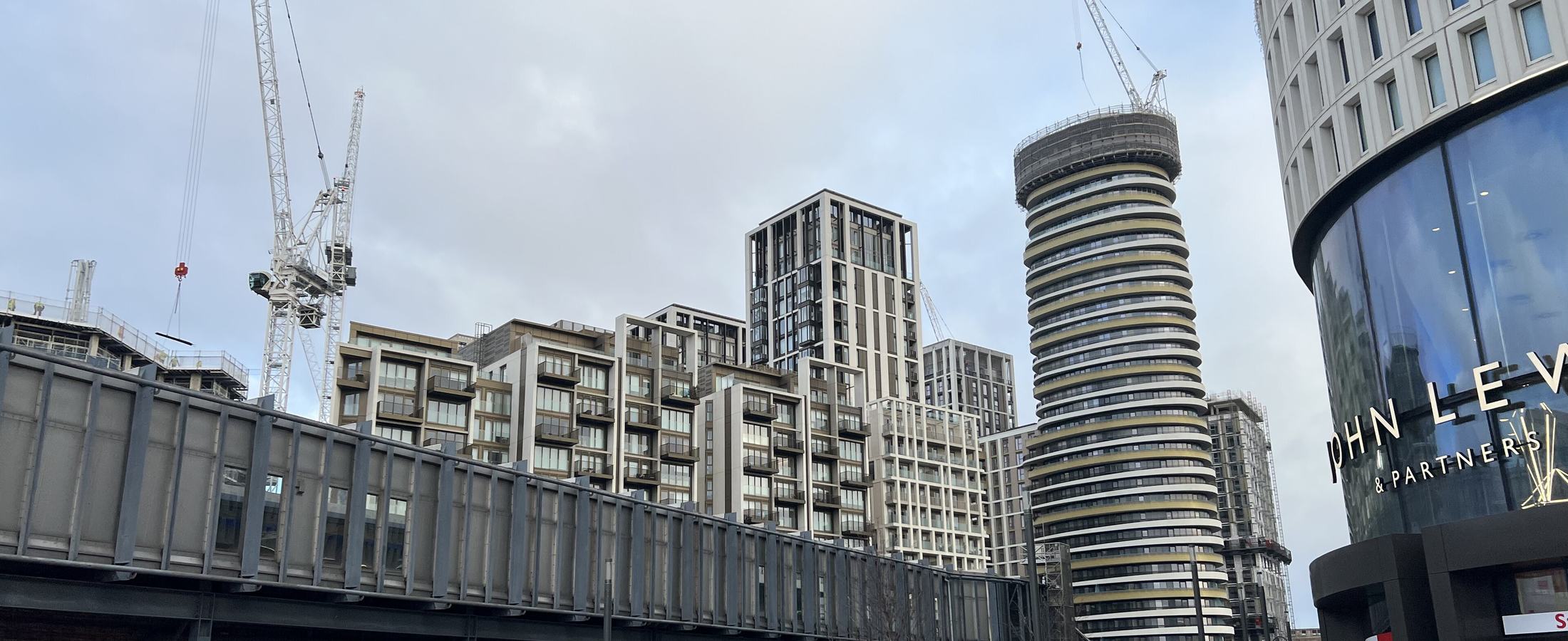
A site that changes shape as the works progress.
Logistics is rarely a single drawing. Access, storage, craneage and the routes materials take all change as the building goes up, and a plan that works during substructure can be unusable by the time the frame is complete. Phasing the logistics alongside the programme shows how the site is intended to operate at each stage, and where one stage constrains the next.
On constrained urban sites this is often what decides whether a sequence is deliverable at all. Delivery routes, crane positions and hoist strategies have to work with the space available, the surrounding streets and any part of the site that stays in use while the works continue.
Neighbours, occupation and handover.
Where a scheme has continuing occupation, neighbouring properties or a phased handover, the logistics and the occupation sequence have to be planned together. Each completed phase removes working space from the rest of the site, so the order in which units are released affects how the remaining work can be built.
Temporary works interfaces are identified as part of the same exercise, so the sequence accounts for what has to be in place, and for how long, before the permanent works can follow.
What is produced.
- Phased site logistics & access plans
- Delivery routes, cranes & hoist strategies
- Temporary works interfaces
- Occupation sequencing & phased handovers
Common questions.
What is a site logistics plan?
A site logistics plan sets out how a construction site will physically operate: site access and egress, delivery routes, storage and welfare positions, craneage and hoists, and the arrangements for the surrounding area. On a phased site it is prepared as a sequence of arrangements rather than a single layout.
Why does logistics need to be phased?
Because the available space changes as the works progress. Positions that are usable during substructure may be built over later, and completed phases handed to occupiers are no longer available to the site, so each stage needs its own arrangement.
Does this cover occupied or phased schemes?
Yes. Occupation sequencing and phased handovers are planned alongside the logistics, together with the interfaces with neighbours and any part of the site that remains in use during the works.