
Podcast · Industry commentary
Can AI help Britain build faster?
Philip Baily joined Mark Farmer and fellow built-environment practitioners on the University of the Built Environment's BE Sustainable podcast to discuss AI, professional judgement and housing delivery.
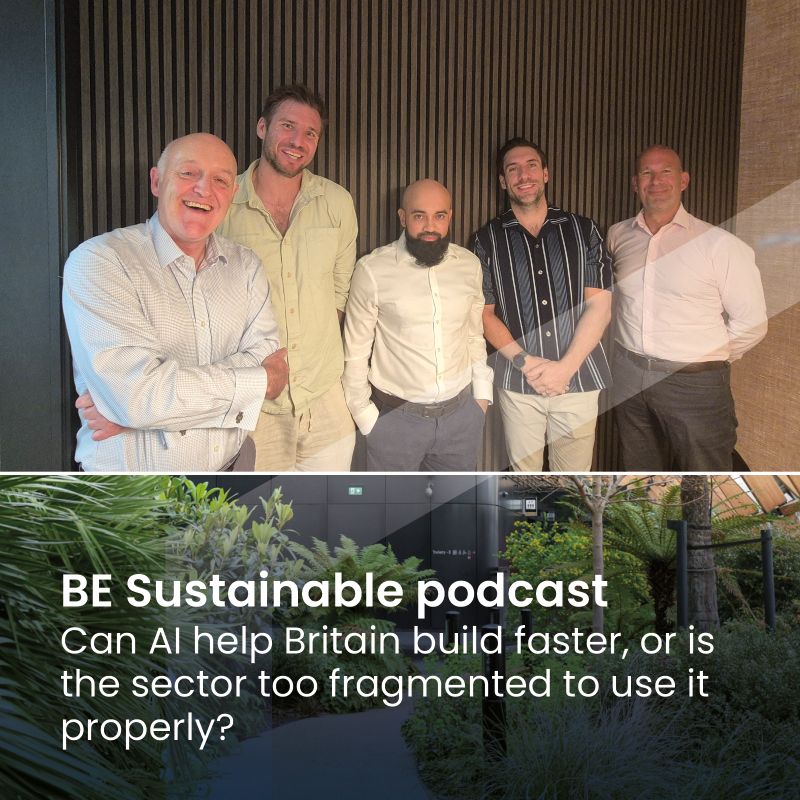
Britain needs to build more homes, and delivering them depends on planners, developers, consultants, contractors and regulators working from the same information. In episode 25 of the University of the Built Environment's BE Sustainable podcast, host Mike Speight asked whether artificial intelligence could reduce delays and speed up housebuilding, or whether fragmented organisations and disconnected data will limit what it can do.
The panel was Mark Farmer, Chair of the Built Environment Futures Assembly; Dermot O'Riordan, co-founder of Xylo; Kamran Choudhury, Head of Innovation at the Chartered Institute of Building; and Philip Baily. The discussion drew on the Assembly's report, Mapping the AI Landscape in the Built Environment, which found a wide gap between how many people already use tools such as ChatGPT informally and how few organisations have adopted AI formally.
What the episode covers
- Whether AI can speed up housing delivery from planning and design through to construction, or whether the real obstacles lie elsewhere.
- Trust, accountability and professional judgement: who is responsible when AI gets something wrong.
- How the sector can adopt the technology without losing human expertise.
- What has to change for AI to make a real difference to the homes Britain needs.
Our view
Most of the time lost on a development is lost between disciplines: a design change that is not priced, a programme that does not reflect the latest information, an appraisal that has not caught up with either. AI tools are already good at reading documents, drafting and checking. Used well, they shorten the time it takes to bring those pieces together, so the people making decisions see the whole case sooner.
They do not remove the need for judgement. Someone still has to decide which assumptions matter, check the output against what is happening on site and take responsibility for the advice. That is where experience counts, and it is the part of the work we do not hand to a tool.